Damaged asset
Could repair substantial structures, borrow against other assets, relocate temporarily and benefit from the civic drive to reopen the tourist economy.
 1926HURRICANE.COM
The hurricane damaged mansions, hotels, rooming houses and workers' cottages—but damage was not the same as recovery. Money bought stronger shelter, transportation, credit and the ability to wait. For renters and wage earners, the destruction of a roof could arrive with the destruction of a job, while long-term relief increasingly favored people who owned property.
The wealthy were not immune. Prestigious oceanfront hotels filled with sand; estates and speculative developments were damaged; major developers lost fortunes. But reinforced hotels, office buildings and substantial homes more often remained usable than lightly built frame housing. Affluence also increased the chance that a household had financial assets, transportation, credit or another place to go. Poor residents had fewer such buffers.
Could repair substantial structures, borrow against other assets, relocate temporarily and benefit from the civic drive to reopen the tourist economy.
Ownership opened a path to repair awards, but a destroyed wooden house, mortgage, interrupted wages and scarce credit could turn recovery into new debt.
A tenant could lose possessions and shelter without owning the structure repaired by long-term aid. The collapse of construction, tourism and real estate threatened the paycheck needed to rent elsewhere.
Many Black residents faced the same poverty risks plus overcrowded neighborhoods, inferior infrastructure, restricted housing choice, unequal relief and—in documented allegations—coerced cleanup labor.
Contemporary estimates placed homelessness between 25,000 and 47,000 people. About 2,000 homes were destroyed and 3,000 damaged. Hotels, private buildings and emergency stations became shelters, hospitals and morgues.
A New York Times headline announced that Miami would open on schedule in January. The statement measured tourism readiness, not whether displaced families had permanent housing.
A Red Cross progress report counted 197 family workers in the wider operation. A separate October report described twelve caseworkers handling about 200 families in Miami Beach.
The dated title “Report of Employers of Labor at Colored Tent City” shows that Hialeah's segregated refugee-and-labor administration remained active two months after landfall.
The Hialeah Press reported more than 125 awards made on December 1 and 2, evidence that formal relief decisions were continuing well into the winter.
A Red Cross final-report press release recorded $2.69 million allocated to homeowners. Marian Moser Jones's archival study identifies a broader pattern of owner preference—an especially consequential divide where many Black and poor residents rented.
Miami Beach had reconstructed much of its physical tourism plant within a few months, but tourism was down and land buyers defaulted more frequently. Construction and property work no longer offered boom-era security.
Tourism and land sales revived temporarily before the national crash. House-price decline and rising foreclosure were already nationwide problems; in South Florida the hurricane struck an economy whose speculative boom had begun weakening before landfall.
Prestigious hotels were damaged, but substantial buildings could be cleaned and repaired. Civic leaders had a powerful incentive to restore the resort image before the winter season. This produced real physical recovery—and a publicity campaign that could make private household distress disappear behind the reopening narrative.
Hundreds of working-class houses were leveled and roughly 70 percent of the town was reported damaged. Red Cross field surveys, camp records, wage comparisons and December awards show that recovery extended for months.
Residents began repairing their own homes while relief and cleanup systems were still being organized. The Ward family account shows how home repair, racial policing and labor demands could collide. Crowding, unpaved streets, limited plumbing and restricted housing choice meant that “move somewhere safer” was not realistic for many Black families.
Miami Beach developer Carl Fisher illustrates that capital did not guarantee survival. The bust, hurricane, heavy borrowing and later national crash sharply reduced his fortune. His loss matters—but a developer losing an enterprise was not the same lived experience as a tenant losing shelter, possessions and wages with no reserve.
In the first weeks: emergency food, medical care, shelter and casework prevented even greater suffering. Reconstruction also created temporary work.
Over the first winter: awards and repairs helped some households, especially owners. Yet a segregated tent city and active family casework months after the storm show that recovery was neither quick nor universal.
Over the next several years: diminished tourism, defaults, scarce credit and the collapse of speculative construction made money and steady work harder to obtain. Renters did not receive the wealth-building benefit of a repaired asset; indebted owners could still lose theirs.
The defensible conclusion: many poor families were materially worse off, and the poorest had the longest and least visible recovery. The surviving household records do not support reducing that unequal experience to a single recovery duration or percentage.
Federal records move the story from citywide estimates to named people, addresses, labor and loss.
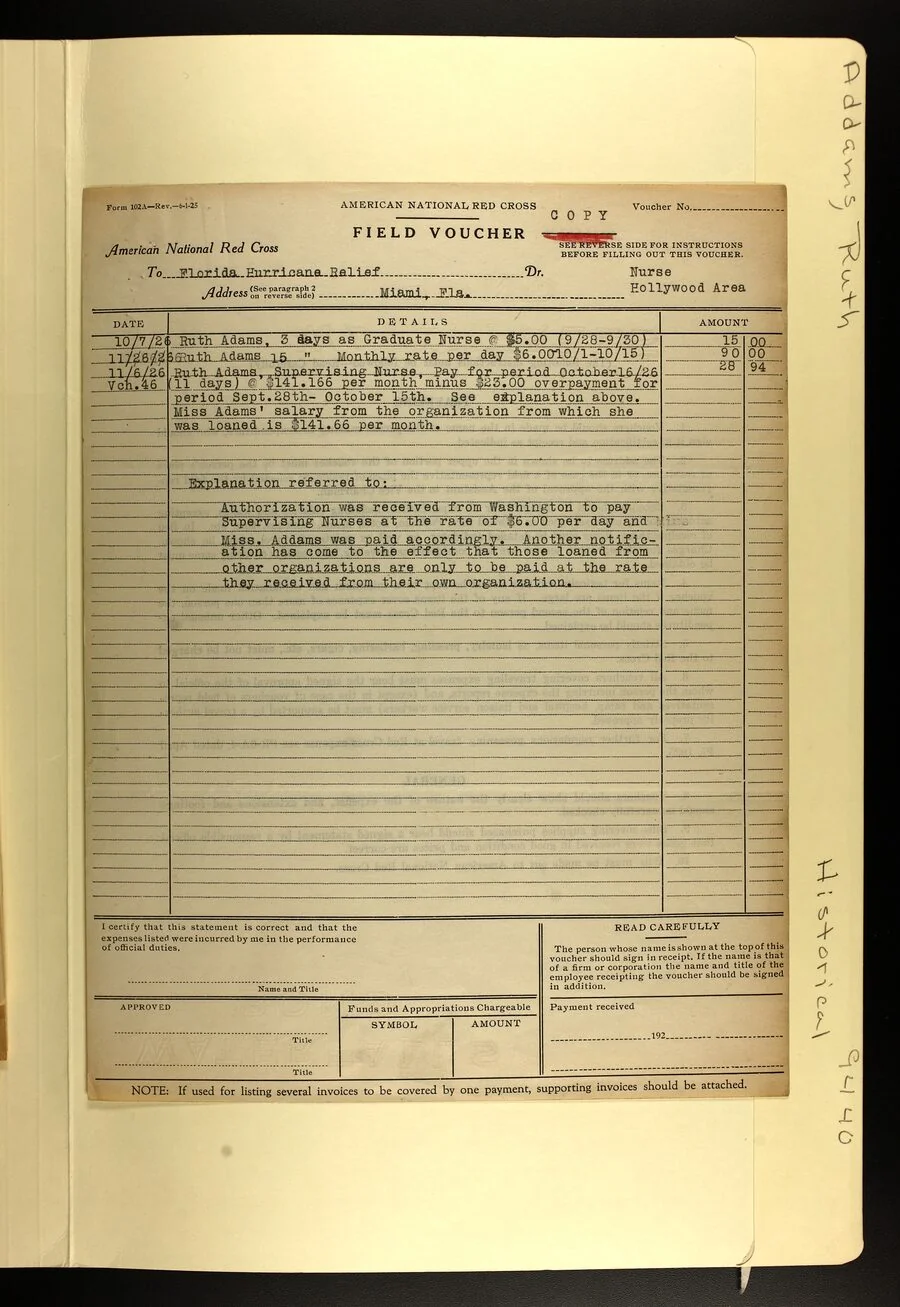
Pages 39–54 of Ruth Addams's National Archives file isolate her 1926 hurricane service. The vouchers and correspondence trace a specific journey: she left Philadelphia September 28, reached Miami September 30, lodged at the Hotel McAllister, moved from Red Cross headquarters into Dania and the Hollywood area, and returned to Philadelphia October 27.
The papers also expose the labor behind relief. Addams entered as a graduate nurse at $5 per day, was raised to $6, and was designated supervising nurse. The Red Cross then recalculated her compensation at the $141.66 monthly salary paid by the Visiting Nurse Society of Philadelphia. She became ill during the assignment and, after returning home, had to pursue $4.72 in unpaid salary and a separate $62.75 expense reimbursement.
Open Ruth Addams: hurricane relief · Open her first travel voucher at NARA ↗
A Coast Guard casualty report identifies a small wooden Miami vessel, transcribed by NARA OCR as Ola, registered to the estate of J. N. Chamberlain and associated with master Max K. Chamberlain of 328 N.E. 35th Terrace. The September 18 casualty occurred at the foot of N.E. 35th Street. The report valued the vessel at $2,500–$3,000, listed no insurance and recorded a total loss after it went ashore on rocks.
The continuation page records “140 miles per hour, as reported by Weather Bureau” and says the master remained aboard until he had to jump off to save himself. The filing was received June 22, 1927—nine months after the hurricane—showing how the documentary aftermath continued long after emergency relief and reopening publicity.
A 1934 Florida Supreme Court opinion supplies the missing household history. John N. Chamberlain, a photographer who moved to Miami in 1896, had raised Max from childhood without formally adopting him. Max worked for John until his 1920 marriage and continued caring for him; Max's wife also worked in the photography business. Neither was paid wages. Instead, John orally gave them a frame bungalow and lot. After John's November 1925 death, his legal heir sued in 1930 to eject the couple. The court upheld their right to the property, treating years of unpaid services, possession and reliance as decisive equities.
This is not yet proof that the bungalow was 328 N.E. 35th Terrace or that the house was damaged in the hurricane. It does show why class cannot be reduced to a clean owner/renter label: a household could possess a home without a recorded deed, build its claim through unpaid labor, lose an uninsured asset in 1926, and still have to defend its housing in court four years later.
Read Chamberlain v. Chamberlain ↗
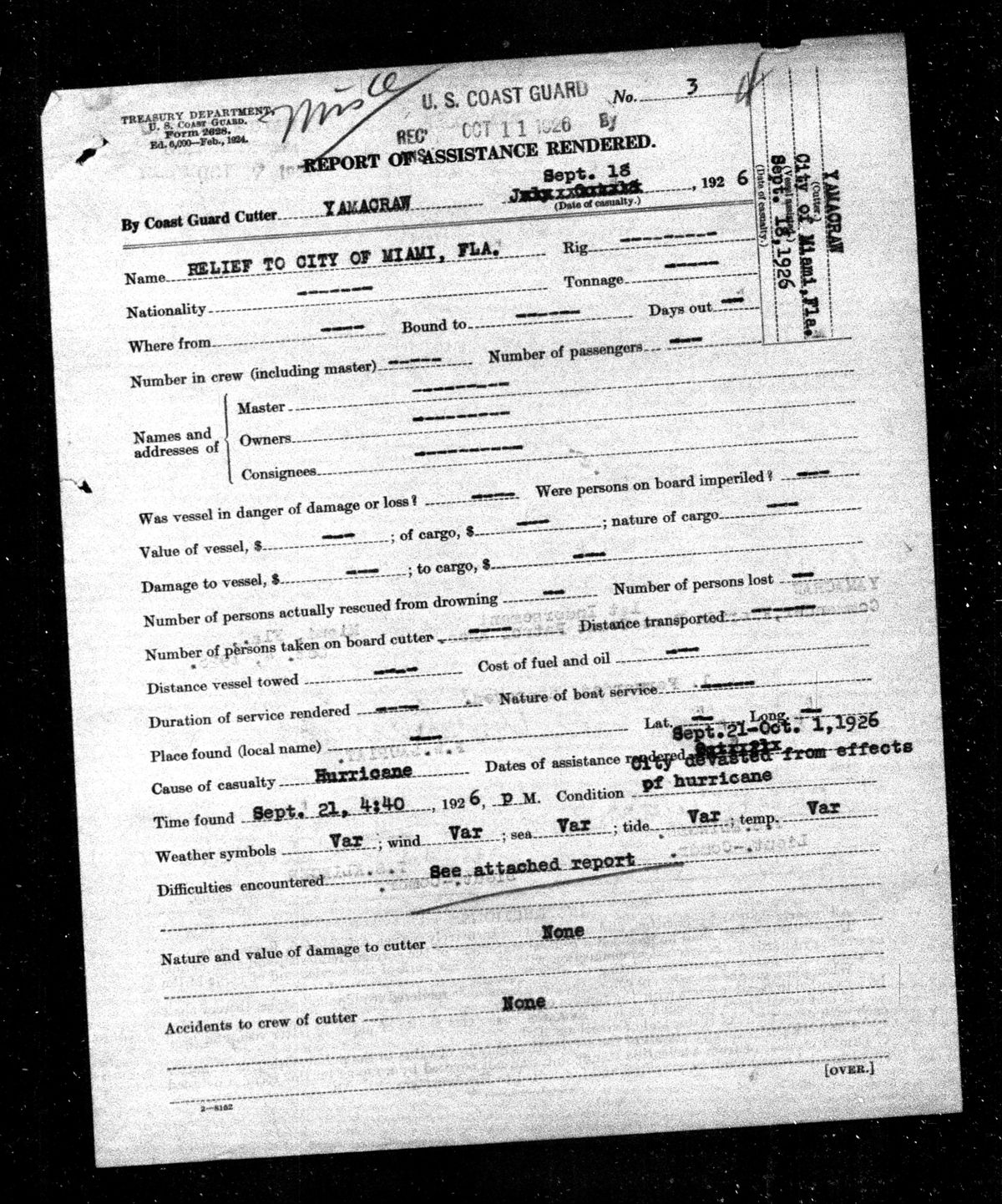
Images 1,037–1,044 of the September Coast Guard assistance reel form an exact Miami hurricane cluster. One report records ten days of Coast Guard city service—policing, moving wounded people to hospitals, looking after the injured and caring for victims' bodies. Three paired reports follow an injured schooner engineer, two Cape Florida caretakers without food or water, and an ill mother and child taken fifty miles from North Cat Key to Miami.
The pages make poverty visible through need rather than a census category: hunger, exposure, exhausted water supplies, missing clothing and inability to reach a hospital. They do not identify the survivors' income or race, so the exhibit does not assign either. They do show that early recovery depended on access to boats, fuel, medical personnel, volunteers, ambulances and overlapping federal, Red Cross and local networks.
Commissioner R. N. Thompson’s January 1927 annual report supplies an unusually specific outcome for the October medical mission recorded by the Coast Guard. The report says two American Red Cross doctors visited nearly every settlement from Sweeting’s Cay to West End and treated 659 people, 122 of them for dysentery. It also identifies unsafe wells exposed to surface drainage from nearby garbage piles and toilets.
Thompson wrote that district health was normal by the end of November and that people had almost entirely recovered from the year’s hurricanes—except at Moore’s Island and Sandy Point, where many vessels and houses had been destroyed. This is an official administrative assessment, not a household survey. It demonstrates that officials could describe general recovery while naming communities where loss remained concentrated.
Compare the commissioner’s return with the original Coast Guard pages
Exact Red Cross file citations establish family-casework counts, Hialeah awards, homeowner-focused spending, camp administration and race-specific limits.
Open article record ↗Documents the scale of homelessness and the difference between structural rebuilding within months and financial recovery over years.
Read the hurricane history ↗Places Florida inside a nationwide 1926 housing downturn and documents residential foreclosure rising after house prices declined.
Read the economic context ↗