Ten original assistance-report pages record individual operations. The authenticated 1927 federal annual report then names the broader program: policing, property protection, hospitals, food and water, body recovery, care for the injured, missing-person searches, waterway clearance, debris removal and rehabilitation.
At sea, in Miami, on Cape Florida and across the Gulf Stream.
These are not a complete account of hurricane relief. They are four reports filed by the cutter Yamacraw and its Florida East Coast Patrol command. Read together, they show federal personnel moving between maritime rescue, city service, Red Cross support and emergency medicine.
September 20–21 · Offshore
Lydia M. Baxter and an injured engineer
The schooner had lost its sails and jibboom, listed to port and carried about two feet of water in the hold after the hurricane. Yamacraw delivered a seven-day supply of food. An engineer struck by flying gear and unconscious for about twenty-four hours was taken aboard, treated, kept at Miami until out of danger, then transferred to the Red Cross for clothing and transportation to rejoin the ship.
September 21–October 1 · Miami
Relief to the City of Miami
The report names no vessel because the city itself is the subject. Its handwritten continuation says Coast Guard personnel rendered hurricane assistance through policing, transporting wounded people to hospitals, looking after the injured and caring for victims' bodies. The form records a ten-day service window.
September 24 · Cape Florida
Mr. and Mrs. Mealer needed a hospital
A fisherman reported two Cape Florida caretakers without food or fresh water and in need of medical attention. Because the unit's boats were occupied elsewhere, a volunteer gasoline boat carried provisions, water, medical supplies, a doctor and a pharmacist's mate. It returned with the couple; the Coast Guard report says an emergency ambulance rushed them to a relief hospital.
September 28 · North Cat Key to Miami
A mother and child crossed fifty miles for treatment
After consultation with the British vice consul and U.S. customs and immigration officials, patrol boat C.G. 294 carried Red Cross provisions and water to North Cat Key. The report says Mrs. E. Schermerhorn, her child Patricia and two estate caretakers lacked fresh provisions and wholesome water. The ill mother and child were transported to Miami for medical treatment.
What the paper trail reveals
Recovery began as survival work.
Relief crossed organizational lines. The pages connect the Coast Guard, Public Health Service, Red Cross, local fishermen, a volunteer boat, emergency ambulance service, a relief hospital, British consular officials and U.S. border officers. No single agency supplied the whole response.
Distance intensified vulnerability. Cape Florida and North Cat Key survivors were not simply waiting in the same relief system as downtown residents. Boats, available crews, water, food and medical transport determined when help could reach them.
The reports also capture needs that property-loss totals hide: exposure, hunger, contaminated or exhausted water supplies, lost clothing, interrupted travel and the physical inability to reach medical care. They give us individual episodes, not a count of everyone who suffered those conditions.
1927 · Authenticated federal publication
The Coast Guard published its own summary of the Miami operation.
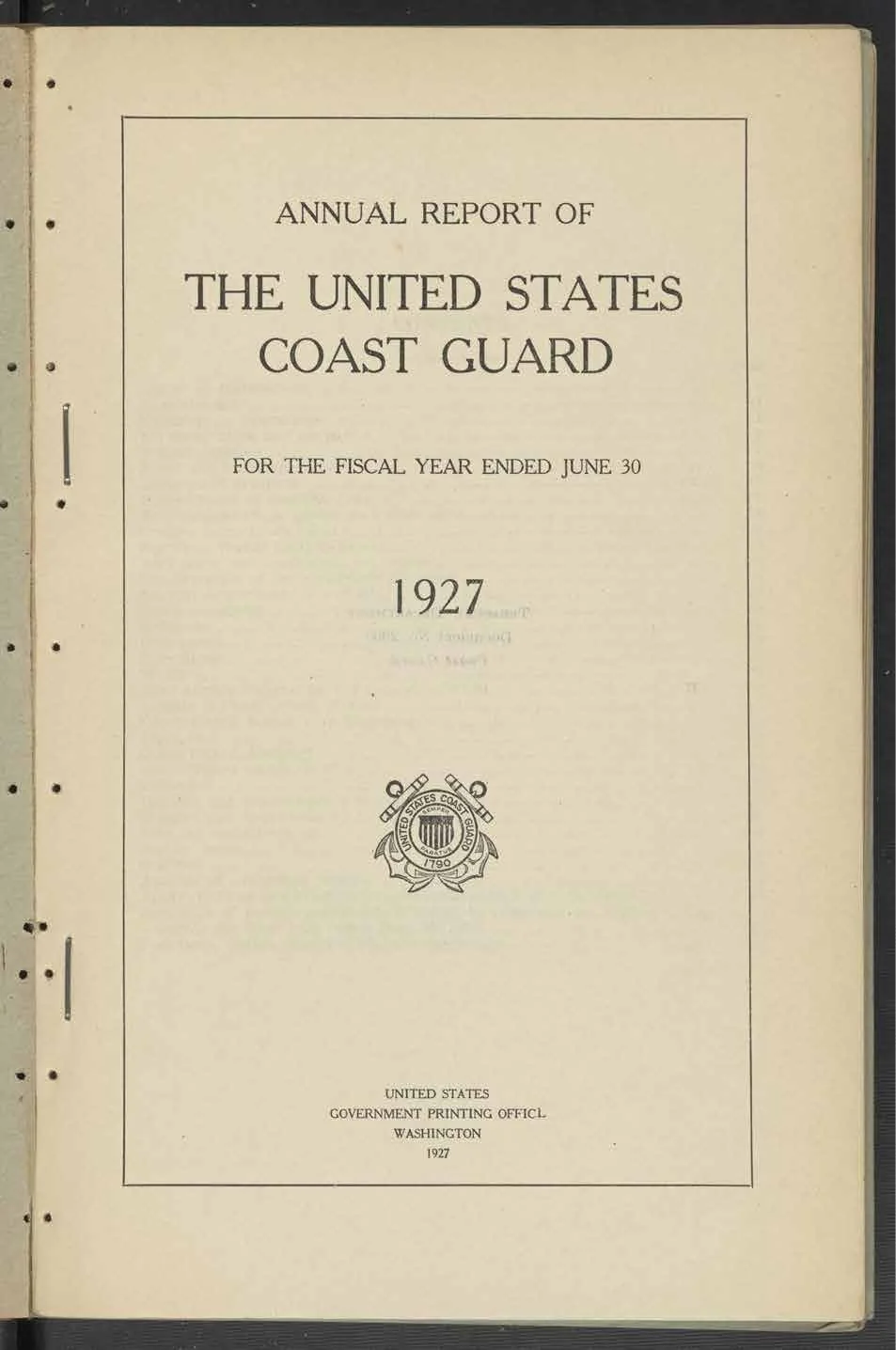
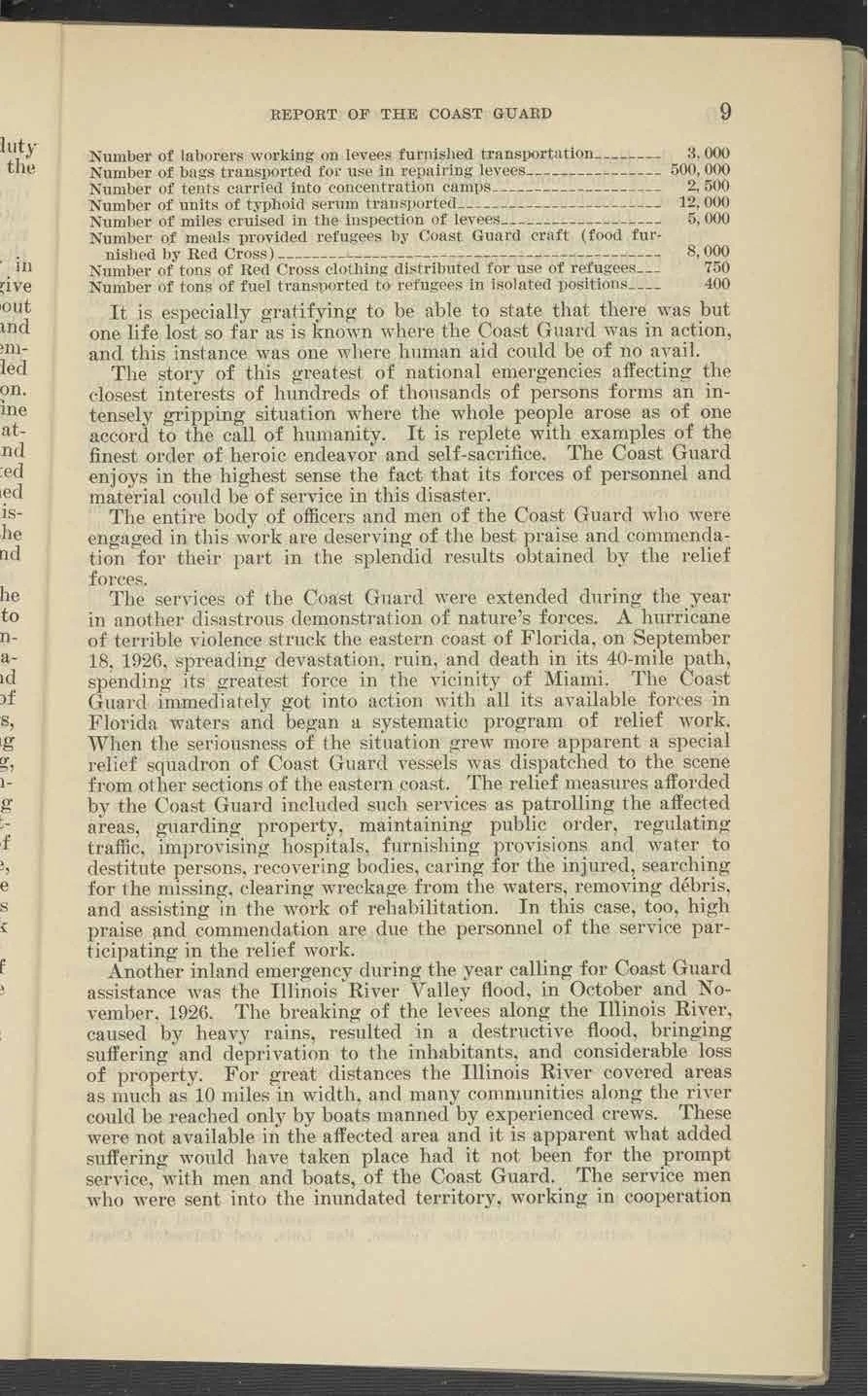
The Annual Report of the United States Coast Guard for the Fiscal Year Ended June 30, 1927 is now preserved here in full from the U.S. Government Publishing Office. Report page 3 explicitly removes the Florida hurricane work from the routine service totals. Report page 9 then describes a special relief squadron and lists the work it performed.
Title page · authenticated GovInfo scan
A complete 72-page government volume
This is an institutional digitization of the published federal report, not a modern transcription. The GovInfo file carries the U.S. Government Information authentication mark and is preserved locally without altering the page images.
Report page 9 · PDF page 18
The broad relief program, in the agency's own words
The report identifies patrolling affected areas, guarding property, maintaining public order, regulating traffic, improvising hospitals, furnishing provisions and water, recovering bodies, caring for injured people, searching for missing people, clearing wreckage, removing debris and assisting rehabilitation.
How to read the evidence: the annual report proves what the Coast Guard publicly said its program included. It does not provide locality totals, names of all personnel or recipients, a racial breakdown, award amounts, or evidence that every listed activity occurred evenly across Miami. The assistance reports below supply individual cases.
Miami’s relief network crossed the Gulf Stream again.
A fifth report, found 968 images into the next Coast Guard reel, documents a Red Cross request for medical relief to Grand Bahama more than six weeks after landfall. Patrol boat C.G. 296 departed with supplies and two named medical workers, met the island commissioner, and divided the mission among settlements.
National Archives image 968 · report form
C.G. 296 receives the assignment
The report form identifies an October 29 mission by patrol boat C.G. 296. Its continuation supplies the purpose, personnel, route and outcome.
West Palm Beach · Settlement Point · Eight Mile Rock · West End
Doctors, supplies and a Bahamian commissioner
C.G. 296 carried Dr. A. B. Wilbur and L. R. Leidig from West Palm Beach to Settlement Point. Commissioner R. N. Thompson joined with a second boat already loaded with stores. The parties continued to Eight Mile Rock; Thompson then carried supplies toward East End while the patrol boat landed the medical workers and remaining supplies at West End.
A significant archival connection: Dr. A. B. Wilbur is also the author of an October 12 report filed in the Red Cross hurricane records in Box 730. That separate report is cited in the archival literature but has not been acquired. This Coast Guard page independently places Wilbur on the later Grand Bahama mission; it does not substitute for, or reveal the full contents of, his October 12 report.
The island commissioner recorded the mission’s medical reach.
R. N. Thompson’s annual report for Grand Bahama supplies the outcome that the Coast Guard pages do not. It states that two American Red Cross doctors arrived with medical supplies in October, visited nearly every settlement from Sweeting’s Cay to West End and treated 659 people, including 122 dysentery cases. The report says district health had returned to normal by the end of November.
What the two files establish together. The Coast Guard record supplies the patrol boat, dates, route, personnel and transfer of supplies. Thompson’s report supplies the island-wide treatment count and public-health context.
What remains uncertain. The annual report does not divide the 659 patients by settlement, date, age, race or diagnosis beyond the 122 dysentery cases. It also refers to two doctors without naming them in the health section; Wilbur and Leidig appear later in its visitor list.
The Grand Bahama Museum presents the official 1927 report as a five-page modern transcription rather than an image of the original typescript.
The eight pages are consecutive images 1,037–1,044 in National Archives reel A-68, “September 1, 1926 THRU September 27, 1926.” Full-resolution repository JPEGs and optimized reading copies are preserved in this exhibit. Open any page to zoom, pan and turn through the sequence.
They establish that the Coast Guard recorded these five operations, the named people and vessels, the service dates, the conditions described by the reporting officers, and specific links with Red Cross and medical relief. The 1927 Coast Guard annual report establishes the agency's published description of its broader relief program. Thompson’s annual report independently records the Grand Bahama doctors’ reach and treatment count.
They do not establish how representative the five field cases were, the race or economic class of the named survivors, the complete medical outcomes, locality totals or a citywide recovery rate. They also do not prove the separate “work or jail,” Colored Tent City or Ward-family claims. Those questions require their own records.
Repositories: National Archives, Record Group 26, Reports of Assistance Rendered, microfilm publication T720. The Miami cluster is reel 68, NAID 583165154, images 1,037–1,044. The Grand Bahama mission is reel 69, NAID 583166475, images 968–969. The Coast Guard annual report is an authenticated U.S. Government Publishing Office scan. The independent Grand Bahama annual report is presented by the Grand Bahama Museum as a modern transcription from the original. These record types remain visibly distinct throughout the exhibit.
 1926HURRICANE.COM