 1926HURRICANE.COM
Primary documents reading room
First-person manuscript · October 21, 1926Kaye’s hurricane letter
A 12-page physical letter preserved by the State Archives of Florida and presented here as 24 digital images, alongside a readable transcription. Kaye wrote from the Floridian Hotel after surviving the September 18 hurricane and another October storm warning, then described her journey across Miami Beach and into devastated Hollywood.
Original source — Florida Memory ↗
October 21 — another hurricane warning
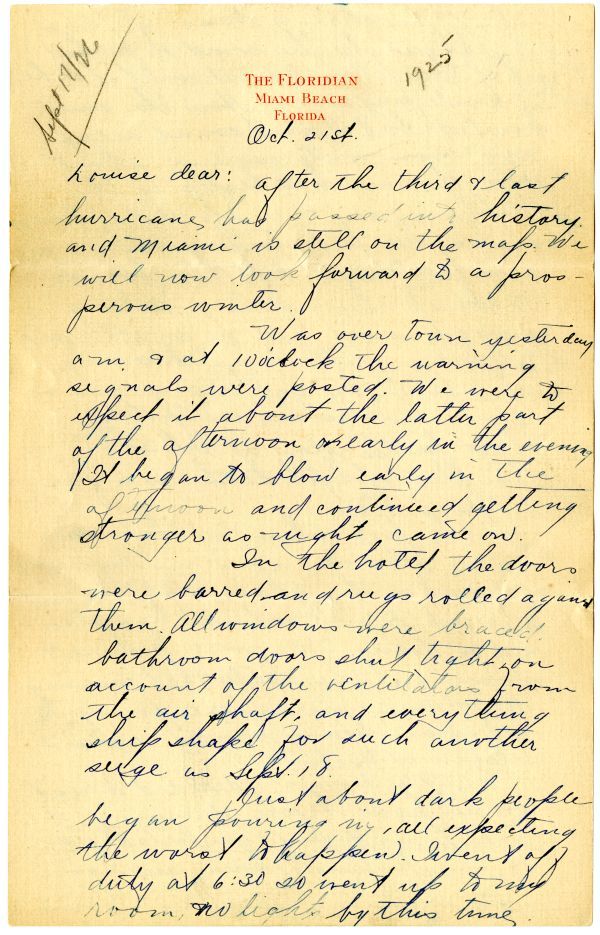
Louise dear: After the third and last hurricane has passed into history and Miami is still on the map. We will now look forward to a prosperous winter.
Was over town yesterday a.m. and at 10 o'clock the warning signals were posted. We were to expect it about the latter part of the afternoon or early in the evening. It began to blow early in the afternoon and continued getting stronger as night came on.
In the hotel the doors were barred and rugs rolled against them. All windows were braced, bathroom doors shut tight on account of the ventilators from the air shaft, and everything shipshape for such another siege as Sept. 18.
Just about dark people began pouring in, all expecting the worst to happen. I went off duty at 6:30 so went up to my room; no lights by this time.
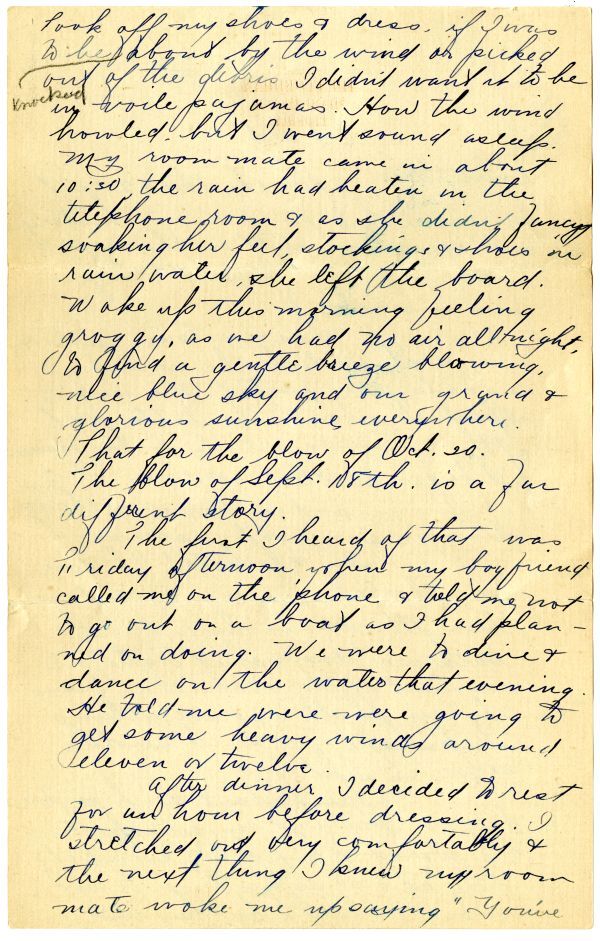
Took off my shoes and dress. If I was to be knocked about by the wind or picked out of the debris I didn't want it to be in voile pajamas. How the wind howled, but I went sound asleep. My room mate came in about 10:30; the rain had beaten in the telephone room and, as she didn't fancy soaking her feet, stockings and shoes in rain water, she left the board. Wake up this morning feeling groggy, as we had no air all night, to find a gentle breeze blowing, nice blue sky and our grand and glorious sunshine everywhere. That for the blow of Oct. 20. The blow of Sept. 18th is a far different story.
September 18 — the storm begins
The first I heard of that was Friday afternoon, when my boyfriend called me on the phone and told me not to go out on a boat as I had planned on doing. We were to dine and dance on the water that evening. He told me we were going to get some heavy winds around eleven or twelve.
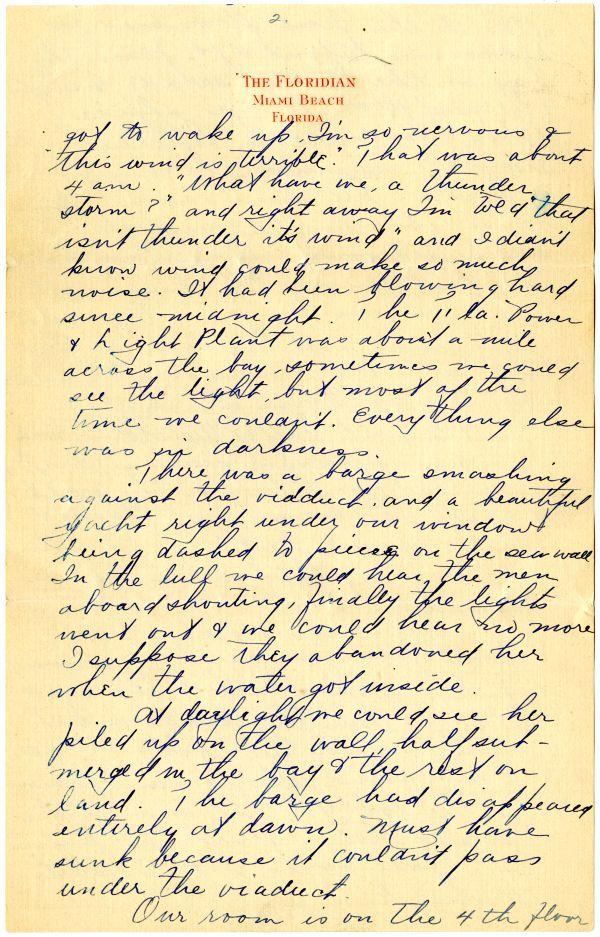
After dinner I decided to rest for an hour before dressing. I stretched out very comfortably and the next thing I knew my room mate woke me up saying, “You've got to wake up, I'm so nervous and this wind is terrible.” That was about 4 a.m. “What have we, a thunder storm?” and right away I'm told “that it isn't thunder, it's wind,” and I didn't know wind could make so much noise. It had been blowing hard since midnight.
The Florida Power and Light plant was about a mile across the bay. Sometimes we could see the light, but most of the time we couldn't. Everything else was in darkness.
There was a barge smashing against the viaduct, and a beautiful yacht right under our window being dashed to pieces on the sea wall. In the lull we could hear the men aboard shouting; finally the lights went out and we could hear no more. I suppose they abandoned her when the water got inside.
At daylight we could see her piled up on the wall, half submerged in the bay and the rest on land. The barge had disappeared entirely at dawn. Must have sunk because it couldn't pass under the viaduct.
Inside the Floridian Hotel
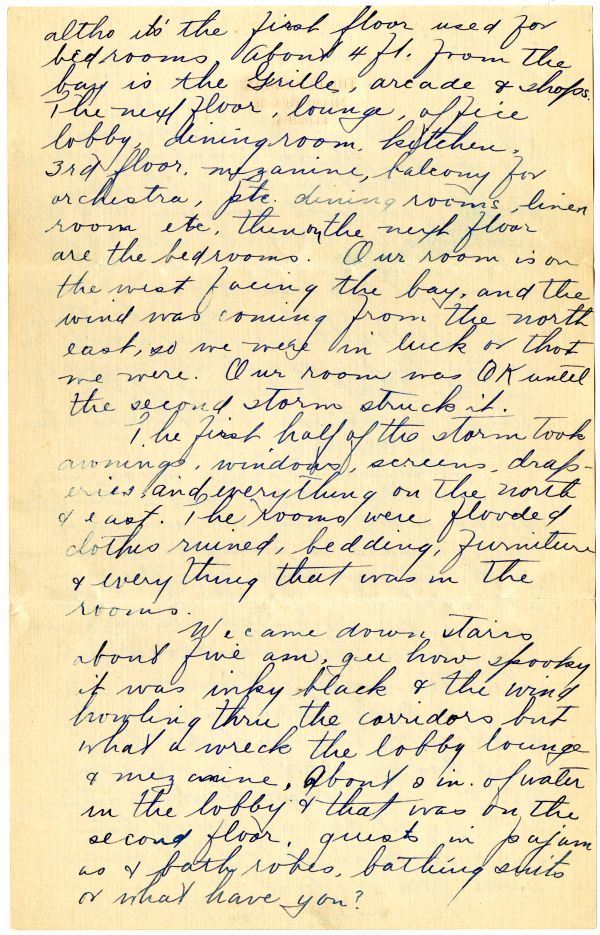
Our room is on the 4th floor, although it's the first floor used for bedrooms. About 4 ft. from the bay is the grille, arcade and shops. The next floor: lounge, office, lobby, dining room, kitchen; 3rd floor, mezzanine, balcony for orchestra, private dining rooms, linen room, etc.; then on the next floor are the bedrooms. Our room is on the west facing the bay, and the wind was coming from the northeast, so we were in luck — or thought we were. Our room was OK until the second storm struck it.
The first half of the storm took awnings, windows, screens, draperies, and everything on the north and east. The rooms were flooded, clothes ruined, bedding, furniture and everything that was in the rooms.
We came downstairs about five a.m. Gee, how spooky it was — inky black and the wind howling through the corridors. But what a wreck: the lobby, lounge and mezzanine; about 2 in. of water in the lobby, and that was on the second floor; guests in pajamas and bath robes, bathing suits or what have you?
One of the boys rescued a tiny kitten from the elevator shaft. Poor little thing was nearly drowned and so cold. I rubbed him dry with my hanky and [unclear] he was the engine-room kitten; I was out a hanky.
About daylight we began getting refugees from all over the beach, some in bathing suits, carrying what clothes they could in suitcases or wrapped in bundles. They looked like immigrants from Europe or Mexico. Some of them swam part of the way.
The second half and rising water
The wind died down and we thought it was all over, when suddenly — bang — a gust of wind from the south took all the windows from that end of the dining room and sent panes of glass spinning the whole length of the room. It was much heavier than the first one and carried all before it.
The big doors to the dining room were barred. The dining room faces south and northwest and all French windows. In an hour there wasn't a whole pane of glass in that room, and the kitchen the same. In the grille on the ground floor, the water was over the tops of the tables and they floated at will. The ocean and bay met there and we were sure it would wash away the foundation and the building would collapse.
Wouldn't you think the people in the hotel would have been in hysterics, fainting, and what not? Everyone was as calm outwardly as if nothing more than a thunderstorm was in progress. Some were crying silently; some, and perhaps all of them, were praying too.
We could see the water getting higher every hour, and that's a long time when every minute you're expecting a building to crash in on you. Couldn't go outside because the wind would blow you into the bay and perhaps on the roof of a building. It was turning cars upside down, ripping off the tops and lifting them right off the pavement.
The kitchen ranges are run by electricity — no current, no eats. They managed to get an oil stove burning and made coffee. It was cold and salty. You know the rain was all salty too. Everything tasted salty for a week.
When the wind came from the south it took everything on the west side. Our room was flooded; my watch was on the dresser and it lay in water until late that night. I'd forgotten it.
Exploring South Beach after the storm
As soon as we were sure the storm was over we began exploring South Beach. What a wreck. In some places we waded in water to our waists, not knowing whether we'd step on a live wire, tin or glass. Anything could be in the middle of the street.
One place, a fruit stand, had been blown all over the place and the owner was busy salvaging what he could, all the time shouting, “Open for business, same place, same prices.” Yes, it was funny. He picked up a dozen apples for us. How good they tasted. We came across a place where they were serving hot coffee, and it was hot. I had two cups of that and felt like a million dollars.
In the morning before the coffee was made they got water-soaked bread; meat was O.K. if you like it all by itself, and bananas. I had a banana, but as there was no water to be had I didn't attempt the meat.
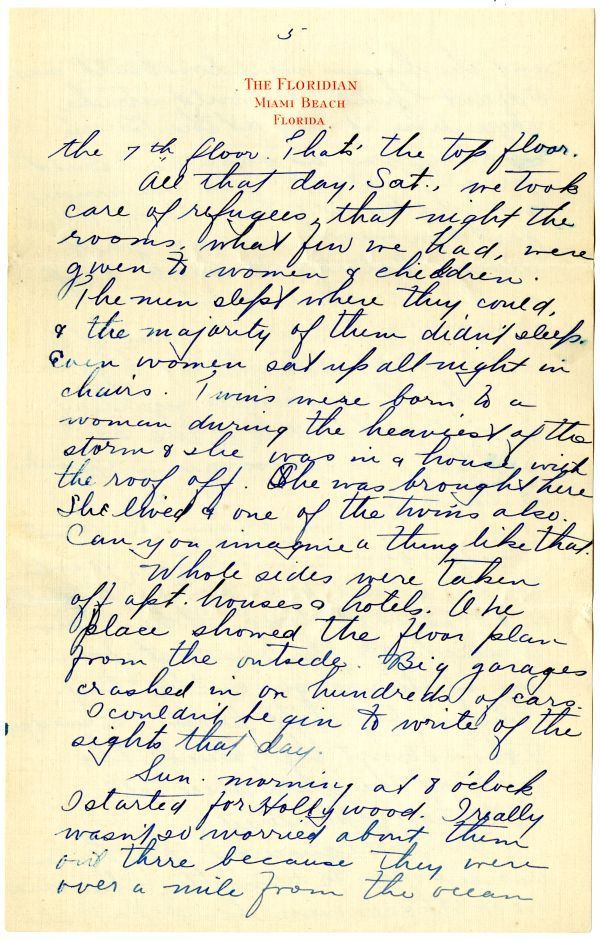
When we came back from looking over the remains of the town, they had quite a force working in the kitchen and at 5:30 they served Irish stew, picnic fashion, in the one-time beautiful lounge. Part of the roof was blown off during the second half of the storm and all the plaster came off the 7th floor. That's the top floor.
Refugees, destruction and the causeway
All that day, Saturday, we took care of refugees. That night the rooms, what few we had, were given to women and children. The men slept where they could, and the majority of them didn't sleep. Even women sat up all night in chairs. Twins were born to a woman during the heaviest of the storm and she was in a house with the roof off. She was brought here. She lived and one of the twins also. Can you imagine a thing like that?
Whole sides were taken off apartment houses and hotels. One place showed the floor plan from the outside. Big garages crashed in on hundreds of cars. I couldn't begin to write of the sights that day.
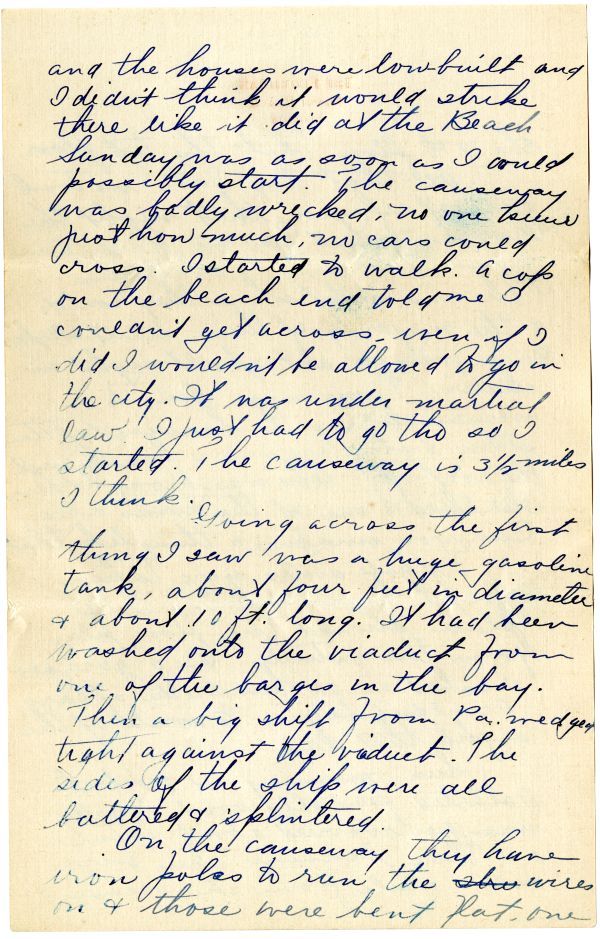
Sunday morning at 8 o'clock I started for Hollywood. I really wasn't so worried about them out there because they were over a mile from the ocean and the houses were low-built and I didn't think it would strike there like it did at the Beach.
The causeway was badly wrecked; no one knew just how much. No cars could cross. I started to walk. A cop on the beach end told me I couldn't get across; even if I did I wouldn't be allowed to go in the city. It was under martial law. I just had to go, though, so I started. The causeway is 3 1/2 miles, I think.
Going across, the first thing I saw was a huge gasoline tank, about four feet in diameter and about 10 ft. long. It had been washed onto the viaduct from one of the barges in the bay. Then a big ship from Pennsylvania wedged tight against the viaduct. The sides of the ship were all battered and splintered.
Across the causeway — the Rose Mahoney
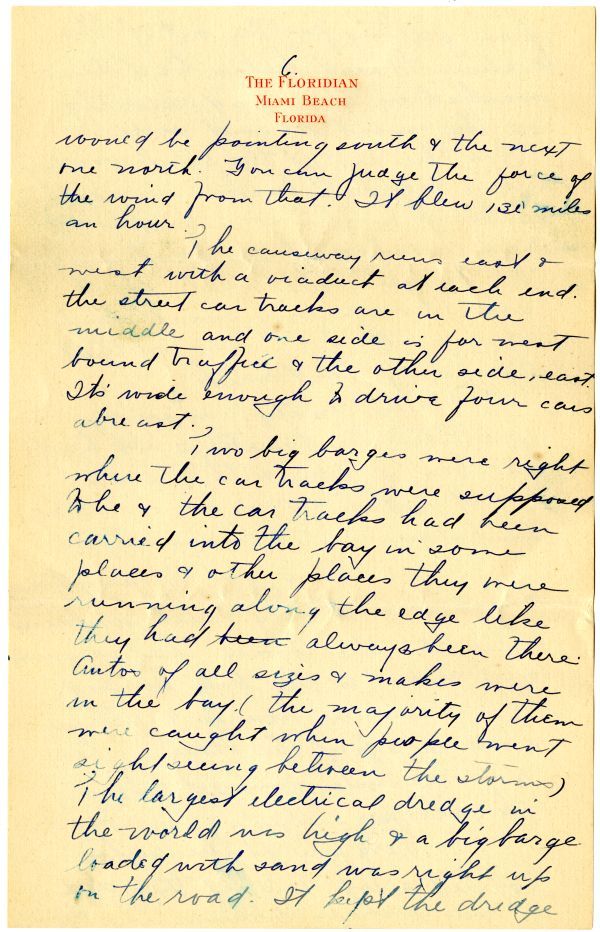
On the causeway they have iron poles to run the wires on, and those were bent flat — one would be pointing south and the next one north. You can judge the force of the wind from that. It blew 131 miles an hour.
The causeway runs east and west with a viaduct at each end. The streetcar tracks are in the middle and one side is for westbound traffic and the other side east. It's wide enough to drive four cars abreast.
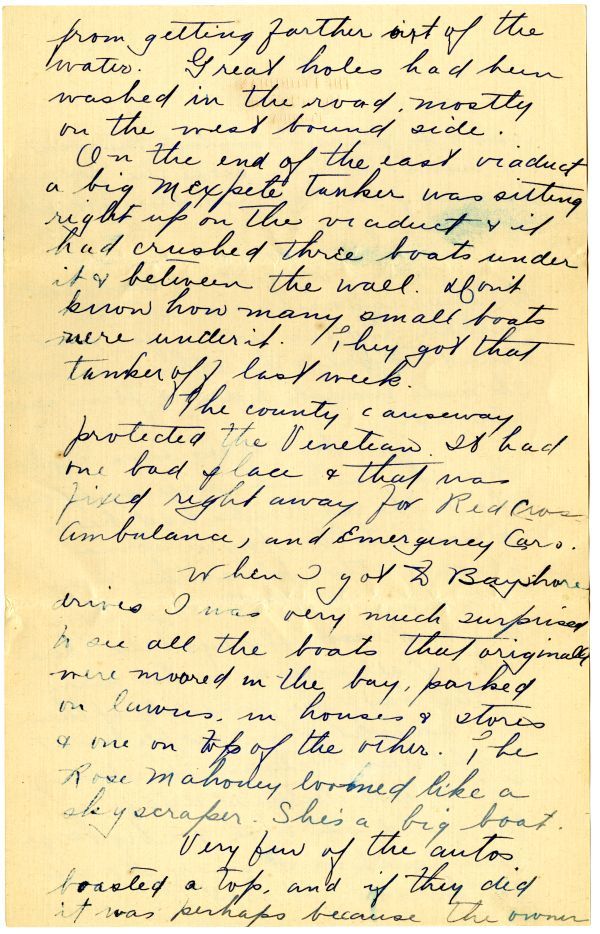
Two big barges were right where the car tracks were supposed to be, and the car tracks had been carried into the bay in some places and other places they were running along the edge like they had always been there. Autos of all sizes and makes were in the bay (the majority of them were caught when people went sightseeing between the storms). The largest electrical dredge in the world was high, and a big barge loaded with sand was right up on the road. It kept the dredge from getting farther out of the water. Great holes had been washed in the road, mostly on the westbound side.
On the end of the east viaduct a big [tanker name unclear] was sitting right up on the viaduct, and it had crushed three boats under it and between the wall. Don't know how many small boats were under it. They got that tanker off last week.
The county causeway protected the Venetian. It had one bad place and that was fixed right away for Red Cross ambulance and emergency cars.
When I got to Bayshore Drive I was very much surprised to see all the boats that originally were moored in the bay parked on lawns, in houses and stores, and one on top of the other. The Rose Mahoney loomed like a skyscraper. She's a big boat.
Trying to reach Hollywood
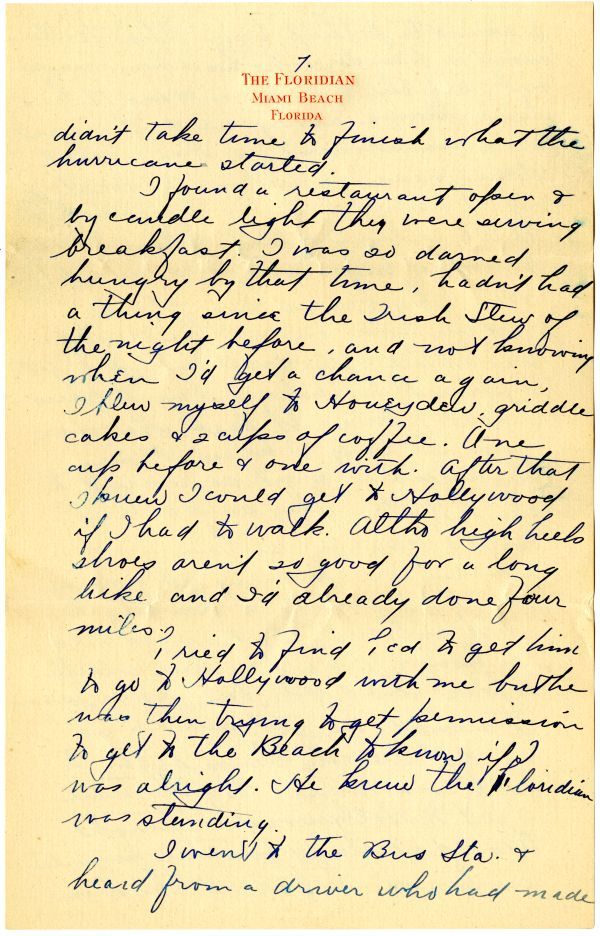
Very few of the autos boasted a top, and if they did it was perhaps because the owner didn't take time to finish what the hurricane started.
I found a restaurant open and by candlelight they were serving breakfast. I was so darned hungry by that time — hadn't had a thing since the Irish stew of the night before — and not knowing when I'd get a chance again, I flew myself to Honeydew, griddle cakes and 2 cups of coffee. One cup before and one with. After that I knew I could get to Hollywood if I had to walk. Although high-heel shoes aren't so good for a long hike and I'd already done four miles.
Tried to find Ted to get him to go to Hollywood with me, but he was then trying to get permission to get to the Beach to know if I was all right. He knew the Floridian was standing.
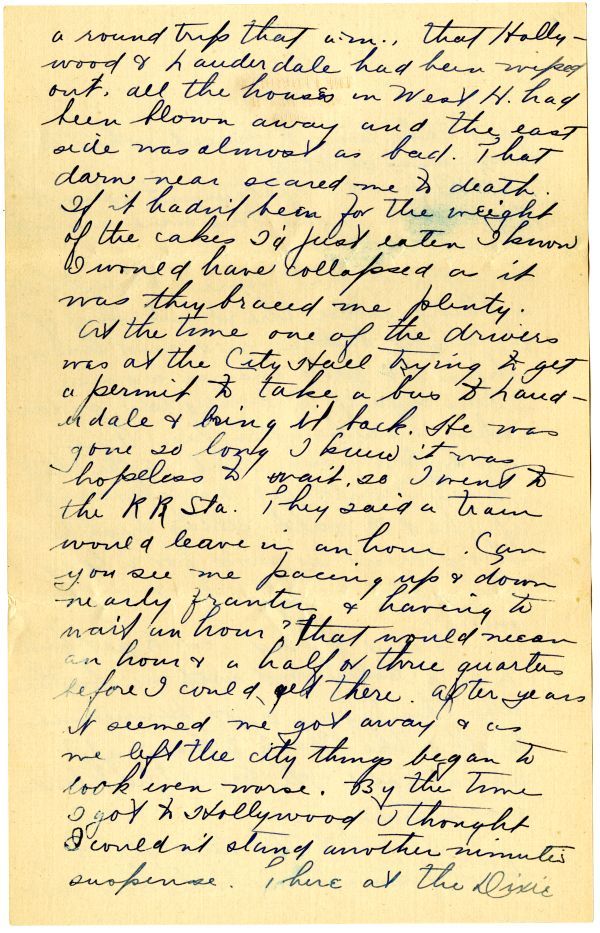
I went to the bus station and heard from a driver who had made a round trip that a.m. that Hollywood and Lauderdale had been wiped out, all the houses in West Hollywood had been blown away and the east side was almost as bad. That darn near scared me to death. If it hadn't been for the weight of the cakes I'd just eaten I know I would have collapsed; as it was they braced me plenty.
At the time one of the drivers was at City Hall trying to get a permit to take a bus to Lauderdale and bring it back. He was gone so long I knew it was hopeless to wait, so I went to the railroad station. They said a train would leave in an hour. Can you see me pacing up and down nearly frantic and having to wait an hour?
Hollywood — searching for family
After years, it seemed, we got away, and as we left the city things began to look even worse. By the time I got to Hollywood I thought I couldn't stand another minute's suspense.
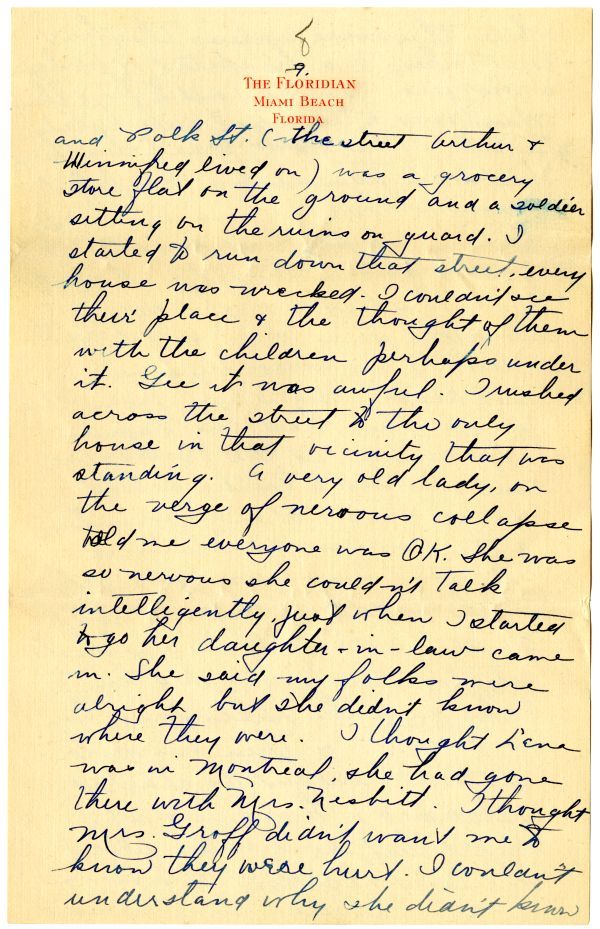
There at Dixie and Polk St. (the street Arthur and Winnifred lived on) was a grocery store flat on the ground and a soldier sitting on the ruins on guard. I started to run down that street. Every house was wrecked. I couldn't see their place and the thought of them with the children perhaps under it — gee, it was awful.
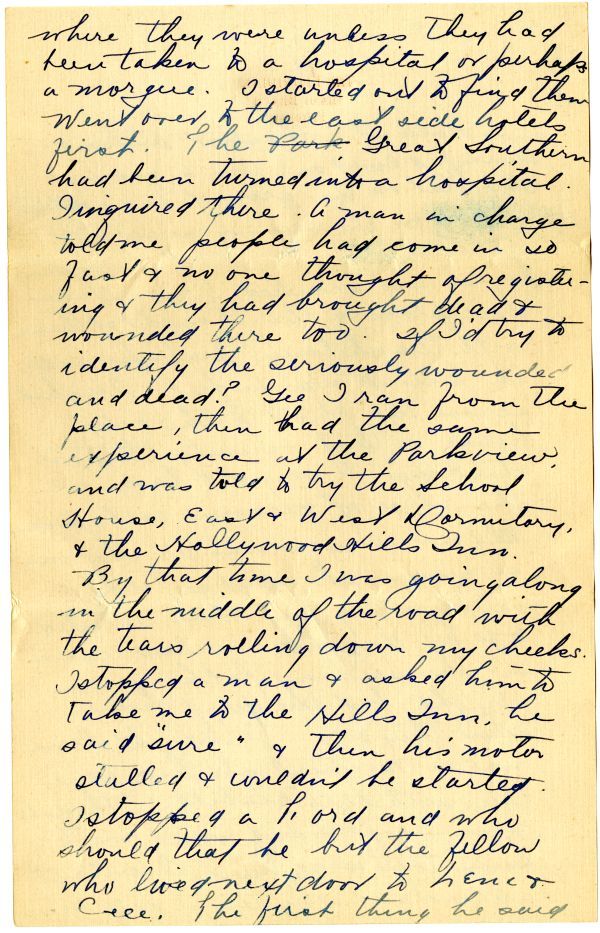
I rushed across the street to the only house in that vicinity that was standing. A very old lady, on the verge of nervous collapse, told me everyone was OK. She was so nervous she couldn't talk intelligently. Just when I started to go her daughter-in-law came in. She said my folks were all right but she didn't know where they were. I thought Lena was in Montreal; she had gone there with Mrs. Nesbitt. I thought Mrs. Groff didn't want me to know they were hurt. I couldn't understand why she didn't know where they were unless they had been taken to a hospital or perhaps a morgue.
I started out to find them. Went over to the east side hotels first. The Great Southern had been turned into a hospital. Inquired there. A man in charge told me people had come in so fast and no one thought of registering, and they had brought dead and wounded there too. If I'd try to identify the seriously wounded and dead? Gee, I ran from the place, then had the same experience at the Parkview, and was told to try the school house, East and West Dormitory, and the Hollywood Hills Inn.
By that time I was going along in the middle of the road with the tears rolling down my cheeks. I stopped a man and asked him to take me to the Hills Inn. He said “sure,” and then his motor stalled and wouldn't start. I stopped a Ford and who should that be but the fellow who lived next door to Lena and Cece.
Family survival stories
The first thing he said was, “Everyone is safe. Lena and Cecil are in the West Side Dormitory and Arthur and children are in ‘The Hills.’” Then he said, “Hello, are you alright? Had to tell you about the folks first because I thought you were going to faint.” It sure made me feel faint, and that's something I don't do.
I met Charlie about 5 o'clock and, as the city was under martial law and I'd have to be off the street at 6, and with a walk of three miles in view, I sure was glad to see that boy. My heels, toes and in fact the whole of my feet were blistered, and they had broken. They had been wet practically all the time since Saturday morning and they were tender. I had had a hunk of glass in my heel and that was just a wee bit painful. On the whole I didn't think I'd ever stand again.
Cecil and Arthur had started to walk to Miami Beach via the beach road — that's 17 miles. Cecil's car had been sort of smashed up and water-soaked.
Lena and Cecil were in the house when it went over. They were standing in the door, waiting to step outside when it started to go down. The suction carried them into the air. The roof landed 75 ft. from the foundation; it was inverted when it came down. They went into the air for a ways and then came down onto the roof. A big ice box went flying through the air and landed 14 in. from their heads. Big pines crashed to the ground but couldn't be heard for the roar of the wind. Their house went down about 5 A.M. and they were in water to their hips until after 12.
Arthur and Winnifred left their house when it moved off the foundation. They went into a house across the street that seemed to be standing it better than the rest. They got out in a lull.
Hospitals, casualties and the night in Hollywood
There were some ghastly sights in the West Side Dorm. One wing had been turned into a hospital. One little girl about 3 years old had a stick driven into her chest; there was a hole as big as my thumb, and she was so good, no fussing at all. A stick went right through a man's heart. He bled to death in a short time. A family of seven, mother and father killed and the five children safe. Hundreds of cases just as pathetic.
That night in Hollywood eight of us had to sleep in one room, had mattresses and blankets, that's all — no nighties, nor luxuries such as water to wash our faces. Mine hadn't been washed since Friday night. Another girl and myself decided we'd go into the dormitory, if necessary take a dead man from his bed for one night. It wasn't as bad as that, because in the corridor we found two singles. We took one, leaving the other in case someone came in in the night and needed it.
The next day I waited in line an hour for a permit to get back in town. The roads were open north to as many folks who wanted to leave, but no traveling south. I told them I was working at the Beach, and after asking when I left, why I left and how I got to Hollywood, and informing me I couldn't come back here, they finally passed me to Miami. Then I had to go through the same thing at the Venetian Causeway, but got through and bummed a ride with a girl driving a Red Cross car.
Kaye's definition — and the strange aftermath
A Miami Beach resident very aptly describes a hurricane: “A hell of a lot of wind in a hell of a hurry.” Don't know as that's what would be found in Webster's, but we who have lived through one can have our own definitions.
Now for the funny side of it. A fellow who works on the Tribune went out between blows for a look-see. He started back home about the same time the wind started from the south. It blew him like a piece of paper across three lots, so he steered himself in the direction of his home and trusted to luck. His luck held; he was blown right through the screen door on the porch, and his mother, seeing him coming so fast, opened the front door. When she did, the suction took the kitchen from the rear of the house and smashed it into the garage. Just fancy — you open the front door and the kitchen blows out the back.
A family living four miles from a dairy found three cows wading around in their back yard. They still had them one week from the storm. People hadn't picked up all their belongings in that time.
People living within a block or two of the ocean were dodging big fish, and when dodging them were falling over the others on the floor. Plenty of fish, but no one had any desire to fish. One man got hit so hard in the head by a big fish as it came through the window that it knocked him out. The snappers weighed anywhere from 3 to 6 lbs.
Closing
I'm sending mother a few views in book form. I sent her a picture of the causeway. If you'd like to see them call her up. If she wants to read this you wouldn't mind. I couldn't possibly do this again in a lifetime. But I do wish I could write of this affair like some people could. However, you asked for it and here it is.
By the way we are promised another for the 28th. Do hope there won't be so much to write about next time. I've sure got writer's cramp in that [word unclear]. Mother would remember that. I went coasting instead of going to church one Friday night in Lent and I suffer for it to this day. Especially if I write; it has been paining steadily for two hours. I started this at 1 o'clock and it is now 5:20.
My gosh, Louise, I'm a wreck.
If this next hurricane is as bad as the one in Sept. I'm going to go north for the skating at [place unclear]. What say? If I write another word my finger will break.
Best love always, Kaye.
Hope I have enough money to pay the postage. Perhaps I'll put a 2-cent stamp on it and leave the rest to you. You'll excuse errors; I can't read this over.
 Digital image 1 of 24
 Digital image 2 of 24
 Digital image 3 of 24
 Digital image 4 of 24
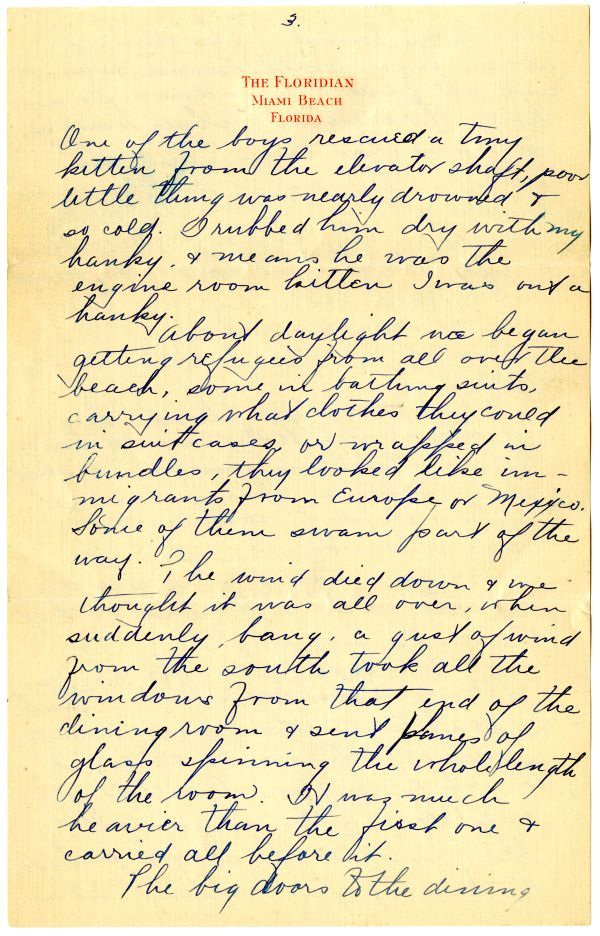 Digital image 5 of 24
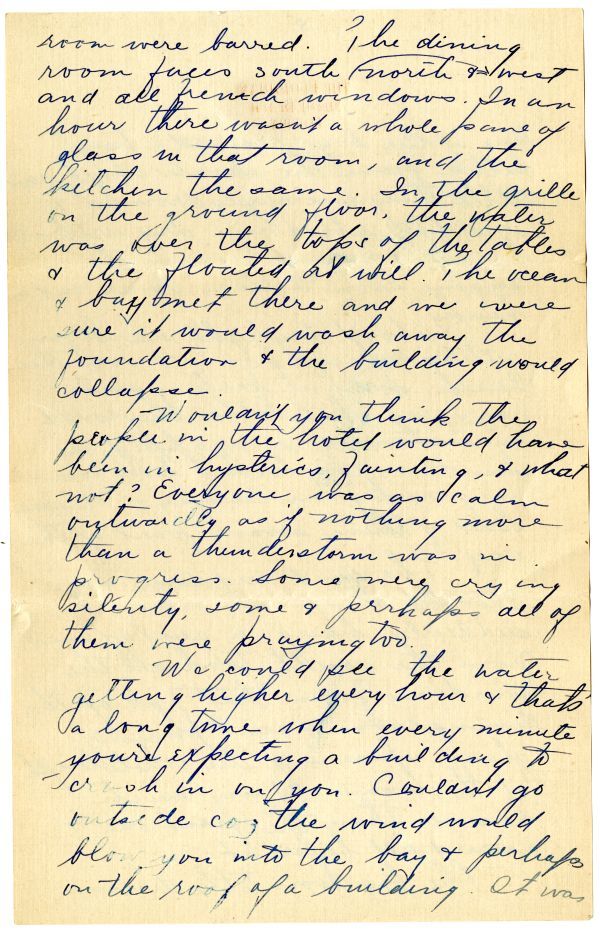 Digital image 6 of 24
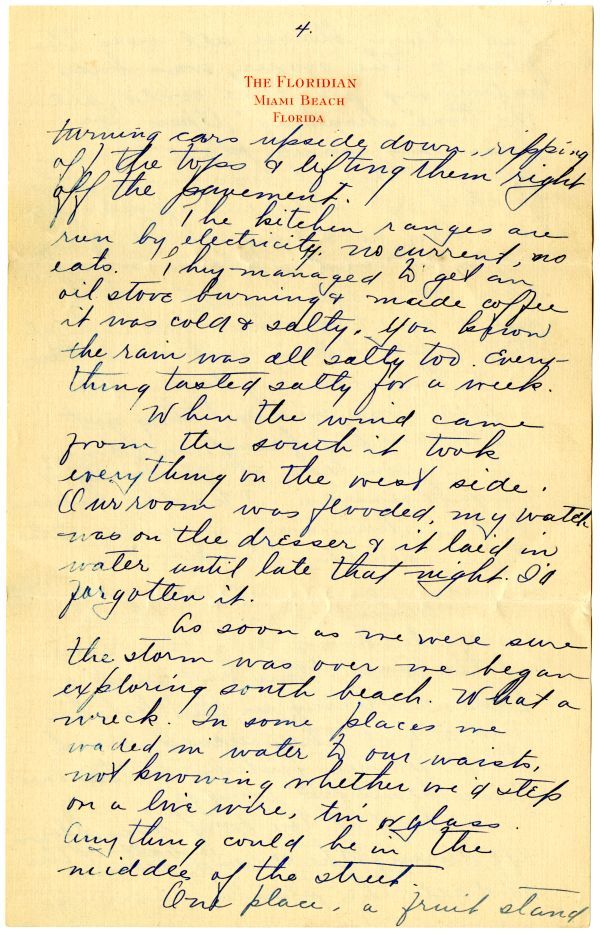 Digital image 7 of 24
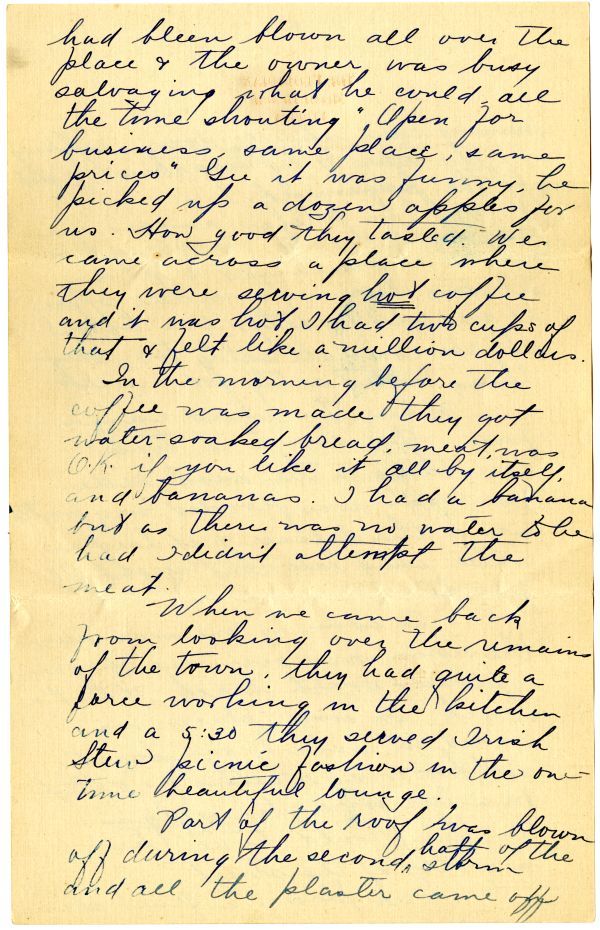 Digital image 8 of 24
 Digital image 9 of 24
 Digital image 10 of 24
 Digital image 11 of 24
 Digital image 12 of 24
 Digital image 13 of 24
 Digital image 14 of 24
 Digital image 15 of 24
 Digital image 16 of 24
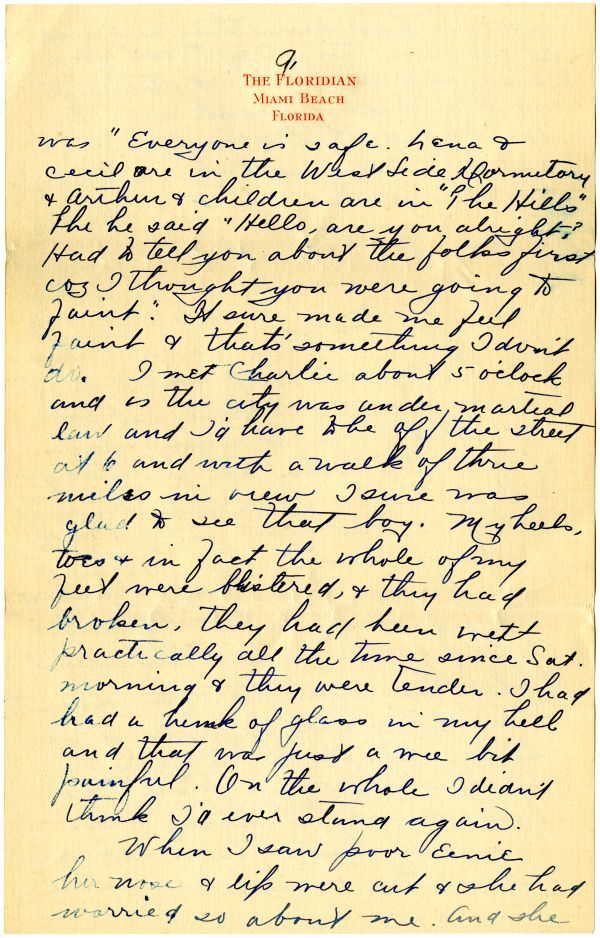 Digital image 17 of 24
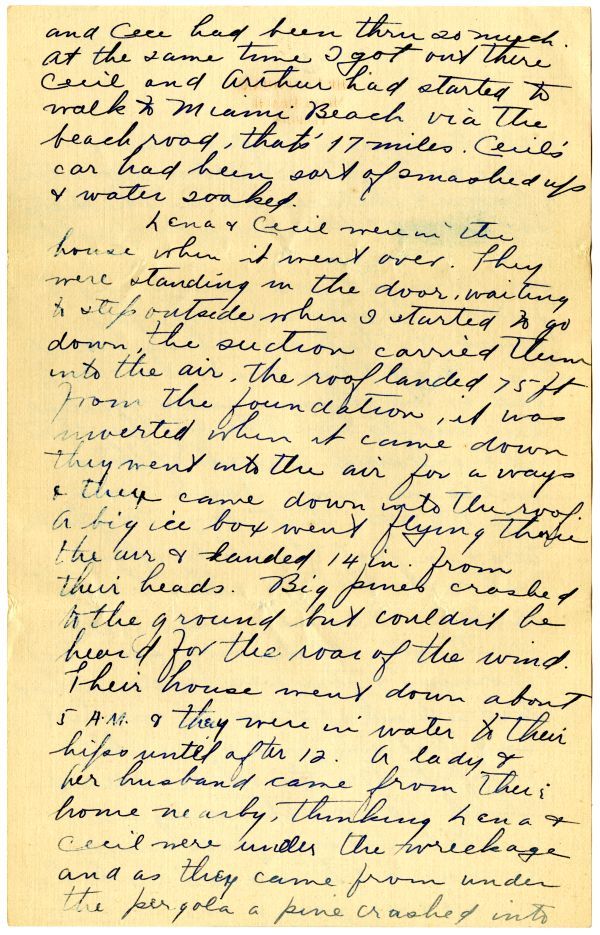 Digital image 18 of 24
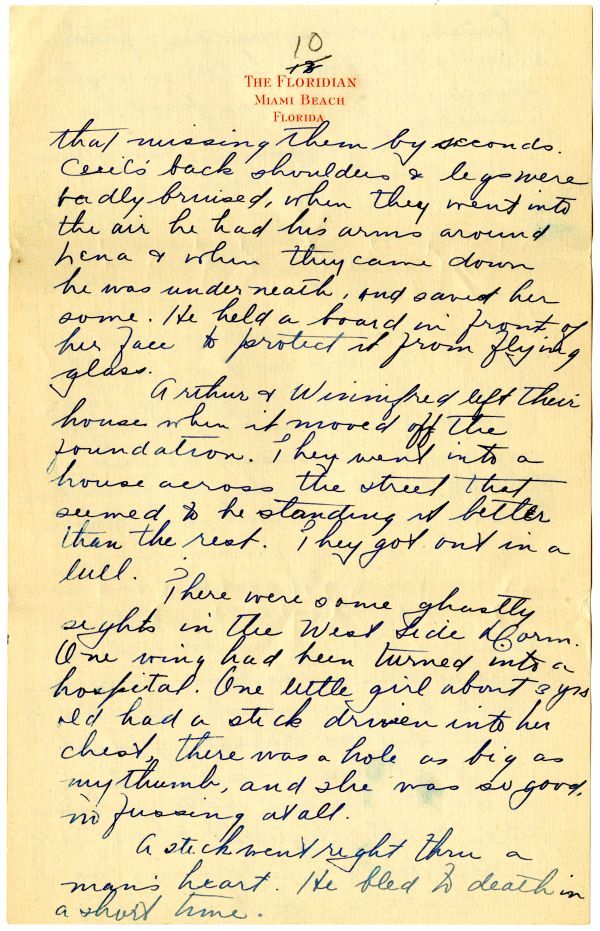 Digital image 19 of 24
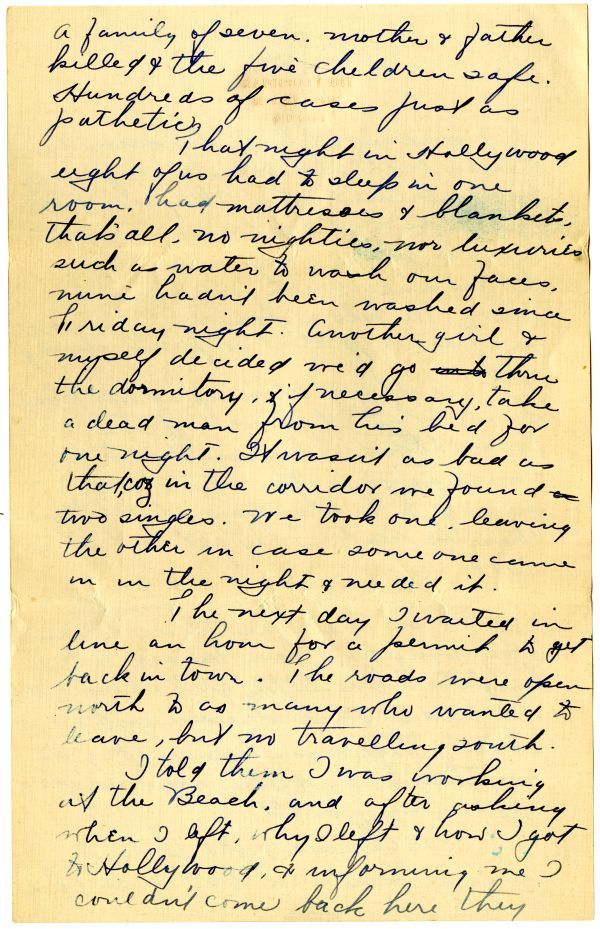 Digital image 20 of 24
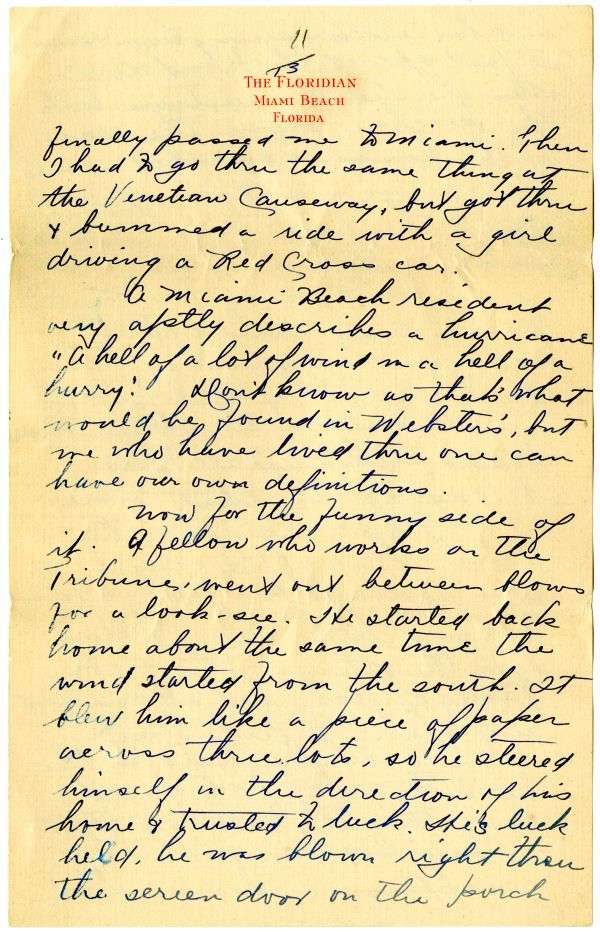 Digital image 21 of 24
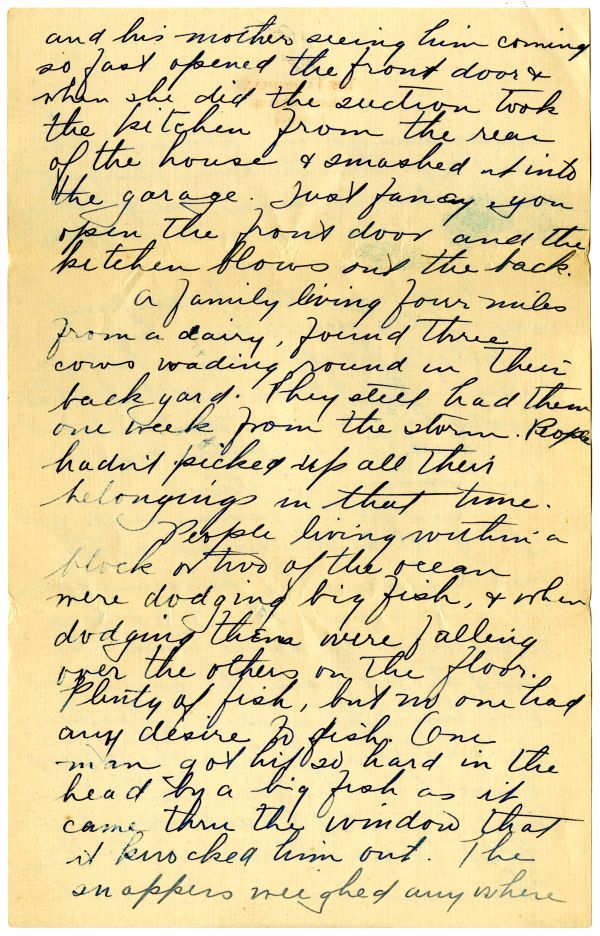 Digital image 22 of 24
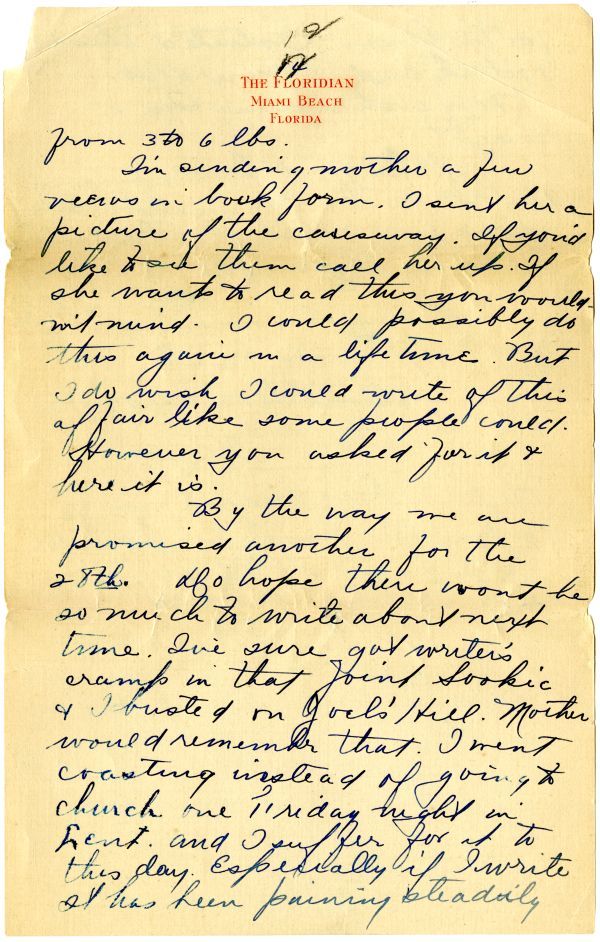 Digital image 23 of 24
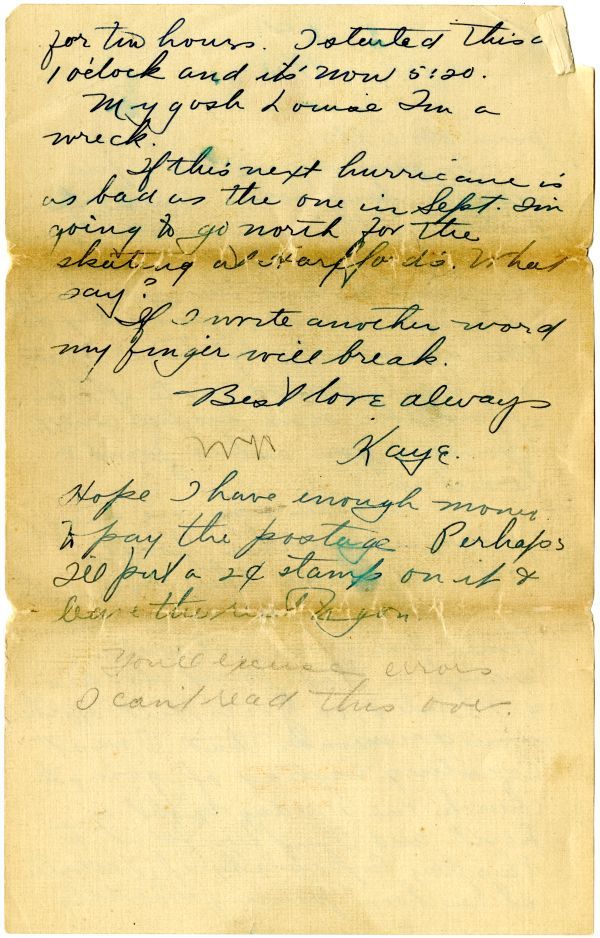 Digital image 24 of 24